Skip to content

Upton Village

South Oxfordshire

  • Home
  • News
    • ‘Upton News’
    • Village News
    • Welcome to Upton
    • Local News
    • St Mary’s News
    • Obituaries
    • Didcot News
    • Oxfordshire News
    • Theatre Club News
    • Village Hall News
    • Wine Club News
    • Youth News
  • Events
  • Parish Council
    • Annual Reports
    • Council Decision Making
    • Council Finance
    • Council Lists and Registers
    • Members and Employees
    • Policies and Procedures
    • Priorities and Plans
  • Amenities
    • Postal Services and Local Post Offices
    • St Mary’s
    • The George at Upton
    • Village Hall
  • Organizations
    • Afternoon Drop In
    • Film Club
    • Friends of St Mary’s
    • HUGS
    • Karate Club
    • Oil and Gas Syndicates
    • Tea Birds WI
    • Wine Appreciation Club
    • Inactive Organisations
      • 50s Club
      • The Upton Coven
      • Theatre Club
      • Village Volunteers
  • Information
    • District and County Council Information
    • Upton Recreation Ground Rules
    • Travel
  • History
  • Photos

Upton in Profile

September 19, 2006

Transcribed from the BBC Radio Oxford broadcast 9th November 1985.

Interviewer John Simpson

In conversation with Mrs. Audrey Stone, of Cherry Cottage, Upton.

JS: One of the things I’ve noticed, many of the houses are tucked away. You can’t actually see them, unless you go looking for them and I’ve come to one such house now to meet up with Audrey Stone, who besides being a local resident of a few years standing is also Chairman of the Parish Council. Audrey, how big actually is Upton? It seems to me not a very big village.

AS: Upton is a small village at the foot of the Downs, with about 450 souls. I think we are about a mile wide and a little over three miles long.

It’s also the sort of village you wouldn’t necessarily come to as it doesn’t actually sit on the main road.

It doesn’t. There are no main roads in the village. It’s all contained around our old Saxon Church. We are linked to villages to the South and to the East by a variety of footpaths. In the South we can go to Blewbury and East and West Hagbourne and by crossing the main road, the A417, we can go by footpaths and green roads to our neighbours Chilton and further afield to Compton and East lisley, and on to the Downs.

And this is very much walking country isn’t it, with the Downs just on your doorstep?

It’s walking and riding country, yes and we’ve worked very hard in the Parish Council to keep these footpaths and green roads open.

Are they used a lot?

They are used a great deal, yes.

And not only by local people I’m sure.

Oh no! People come from far afield to walk here.

If you get walkers, do some of them come in their cars, deposit their cars, then walk? If so, what happens to the cars?

Mostly they come to gain acess to the Downs so they tend to park either in the pub car park or at the end of the Lynch Way, which is one of our green roads and walk up from there.

So, no great problems.

No great problems, no.

Tell me a bit about the make-up of the village. What sort of village is it these days?

Like many villages, it’s made up of local people, people who have come here to work and go out each day to Harwell, Oxford, Didcot. We’re a good mix, a happy village I think and people aren’t backward in coming forward to say how they want the village to develop.

Yes, now that actually is quite an important point, because it’s quite a picturesque spot here, with the Downs, as I’ve said, right at your dooorstep and driving around I’ve noticed there’s still one or two of the very old cottages, superb brickwork and half timbered, so they’re still here and then you’ve got a mixture of modem buildings. Very important that everything sort of hangs together, because you could spoil it very easily.

Yes, very easily. The Parish Council and the village I think want it to remain a small village. We don’t want any more large buildings in Upton. We would like to see perhaps another group of local authority housing for the elderly and maybe a small group of houses for first-time buyers. We don’t want to become any larger. We don’t want to reach out to our neighbours.

Actually, walking around just now, there is some development going on at the present time.

A large house in the village, with an equally large garden, was sold in recent years and the garden, in the way of most large gardens, has been sold off. But we were able to reach a compromise over that. Ten houses were asked for and by much negotiation, we got it down to five and the village is happy with that.

The other thing I noticed was an extremely large playing field.

We have a playing field of 5 acres. It was bought by public subscription, Coronation year 1953 and is called “Coronation Field”. In those days, we had a village school. The children used the playing field and the local authority cut the field. With the closure of the school, the local authority stopped cutting the field and the Parish Council took it on. It costs a lot of money to keep it cut and tidy. We have a very old tractor, of Eastern European origin, which we manage to keep going and we pay a man to cut the field. It takes a large chunk of our precept.

It certainly looks very good though. As I came past it, it’s most noticeable that it was well kept.

Yes. we put a lot of work into it and some voluntary work goes into cutting around the swings and slides for the children.

I must ask of course, is it well used?

It is. We have two teams on a Sunday, the local pub team and recently, a team from Abingdon.

This is football, is it?

Yes, football on Sundays and recently the children were in trouble because they used the Village Hall surrounds for cycling with their bicycles and lots of bits of damage was caused, so during the summer holidays the Parish Council and the children and the older residents in the village got together. The children produced a plan for a small cycle track which they constructed themselves on a piece of playing field which we’ve loaned to them and it seems to work very well.

Having put all the hard work into building it, I’m sure they appreciate it now.

They do.

Also of course there’s the Village Hall, which again I would think is an important part of the village.

That was built by voluntary local labour some years ago and is run by Upton Amenities Trust. It’s not a Parish Council responsibility, although it stands on our land. It’s used a lot. It’s used for most things in the village of course, although the Methodists do have a large hall, which they rent. But, unfortunately, the Methodists don’t have a licence.

Well let’s just turn to yourself. How did you come to be here in Upton because I think you’ve been here a few years haven’t you?

We came in 1961 when my husband left the navy and obtained a job locally and found this piece of land and built a house on it.

It’s tucked away, this piece of land, fairly lucky to find it, I would think.

Very lucky! It came on the market at the right time and we were ready to come into civilian life and we bought it and we’ve been very happy here.

Did you know Upton before you came?

No, not at all, no.

In fact what were your impressions when you came, it’s a few years ago now isn’t it?

I remember coming into the village to look at another piece of land and thinking, is this village inhabited? No one came out to say “Hello.” I don’t know where they were that day. I thought to myself, could I stand living in a small Downland village after coming from a very busy service life, but we did and we’re pleased now we took the plunge.

Filed Under: History

Old Upton

September 19, 2006

A history of old Upton

Pre-history

The earliest evidence we have of habitation in Upton is some time during the iron Age (very roughly, after 600 BC) when the settlement lay within the territory of the British tribe, the Atrebates. The tribal capital was Calleva (Silchester) which, in the 1st century AD, came to be the important Roman town, Calleva Atrebatum. The territory administered from here lay south of the Thames in Berkshire and the adjacent parts of Wiltshire, Hampshire and Surrey. The name Airebates means settlers or inhabitants.

Of course we have no definite dates for any of this early period, nor do we know of any earlier, Bronze Age, settlement here. There are traces of old field systems in the fields north of Common Lane (where the Red Barn stands), and I am told that pieces of pottery, metal and ornaments from the Romano-British period have been found in the fields beyond Frog Alley Farm. There is also a tantalising glimpse of the archaeology of the village: the Rev Richard Hooper, first rector of Upton, kept a parish diary from the spring of 1862. The following entry appears on 29 June 1863: “In the afternoon Mr Philip Humfrey, accompanied by the Rev J C Clutterbuck (of Long Wittenham) and myself examined a curious cave or grave on his Downs at Upton and found numerous bones of animals and some Romano-British antiquities”. This spot was marked on Ordnance Survey maps of the area (“Stone Rings etc found”) until quite recently, but the new maps no longer show it, and the “grave” has long since been ploughed out. What happened to the antiquities and whether Mr Hooper was correct in dating his finds to the Romano-Bntish period we do not know.

The earliest known archaeological sites in the village probably date back to the Anglo-Saxon period. Two chalk-cut graves (c 1000 AD) were found in 1958 below Athelstone and Ryecroft in the High Street. In the first burial was found an iron knife (now at the Ashmolean Museum) and an iron boss of a shield. Later in the 1980s, another grave, probably of similar date, was found in Prospect Road.

While on the subject of archaeology, I am sure Maitland Underhill, the local historian I have mentioned before, who lived in Upton, would not have objected if I draw from his “Notes on Upton” at this point:

“From 1969-71, fragments of Norman pottery have been turning up in the garden of my bungalow, Turstins (now Sunnybank) … These fragments comprise at present at least eight different pots. There are also pieces of 16th – 19th century and later wares, stems of clay pipes, etc … Some of the pottery uses a distinctive pinkish-brown paste, probably wheel-made with a roulette stamp. Another large portion is of blackish-grey hard paste, with the top of the rim having a characteristic finger-indented “pie-crust” surface.

“On 1st November 1970, I recovered two pieces of similar blackish-grey ware and a later piece of red-ware from the upturned foundations of the new house now completed in Fieldside Road. (I am not sure which house this was, but it was the church end of Fieldside JG) There should of course be Saxon pottery as well to be found, assuming that there was late Saxon occupation.

“Before 1970, a 14th century “jetton” or casting counter was dug up in a garden in Fieldside Road, together with some 17th – 19th century pottery from the same garden. In 1960, a hoard of seven silver coins of Elizabeth I, James I and Charles I were unearthed beneath the foundations of three old cottages demolished close to the old Methodist chapel on the east side of High Street. The coins are now in Reading Museum.”

There were other, probably late Anglo-Saxon, burials found at the White House, at the very eastern end of the village, but as this lies just within the parish of Blewbury, they cannot be counted as Upton finds. However, together with the High Street burials, they do point to the possibility of a cemetery yet to be discovered on the north side of the old Icknield Way (A417).

Documented History

Now, to the first written references to Upton. From The Early Charters of the Thames Valley by Margaret Gelling, I quote:

“Record by Alfred King of the Saxons, of the transaction by which he acquired 100 “manentes” in Ceolesige (Cholsey) and its appurtenant vills Haccaburna (Hagbourne) and Bæstlæsford (Basildon) from Bishop Denewulf and the church of Winchester.”

The bounds of Haccabernan describe East and West Hagbourne with Didcot, Upton and probably Chilton. The date of this charter would have been somewhere round about the year 895, during the reign of King Alfred. Though Upton is not mentioned by name, the inclusion of Haccabernan would most likely indicate that there was a settlement at Upton at this time.

The first definite written record of Upton appears in the Domesday Book. This great work was compiled for King William, dating from 1086, as a record of “what or how much each landholder held … in land and livestock” for the entire kingdom. The entry for Upton reads as follows:

Thurstan son of Rolf
In Blewbury Hundred
Thurston also holds UPTON. Britric a free man, held it.
Then for 10 hides, now for 5 hides
Land for 9 ploughs,
In lordship 2;
16 villagers and 7 cottagers with 6 ploughs,
7 slaves; meadow, 30 acres
The value is and was £13.

The hide – originally signified the amount of land which could be ploughed by a team of eight-oxen. …This varied according to the quality of the land but was usually between 160 and 180 acres.** It seems then that the land acreage here, at its smallest, was about 800 acres compared with the present parish of about 1380 acres. The population though was tiny. What we have here is the original Manor of Upton. Over the years, with the division of the manor into four parts and the consequent gradual acquisition of more land, the village eventually grew to the size and shape of the present parish. The parishes, to quote from the same source as above, dated “from the ninth and tenth centuries, when parish churches superseded the Minster system. Most early parish churches were provided by Saxon lords, the boundaries of whose estates almost certainly corresponded with those of the parishes.”

Margaret Gelling, in her book The Place Names of Berkshire, lists about forty old names from Upton, mostly field names and farm names. I clearly cannot mention them all, and of course many or most fields and farms were simply named after their owner, or past owner, or tenant. For instance: Old Tommy’s Farm, Gammons Downs, Rixes Meadow (this name, variously spelt, is the same as the name Rich, still found locally as in “Rich’s Sidings”), Aliens Barn Piece, Butlers Meadow, etc. There are also names whose origins are now lost: Adnams Grave (which could be a corruption of Grove. It lay across the road from the old Rectory), Lady Half and The Coobies (by the road to The Horse and Harrow), Scotland Piece (also in that area), Milhains and The Forty (off Common Lane), Picked Piece, Romans, Grumbles Mere, Saffron Close (did they grow saffron here?), and others like Withy Hedge Piece and Granary Orchard which need no explanation. Some of these names are still used, but most have been lost from the village memory.

The parish registers come next, an absolutely invaluable source for the local historian. They start in 1588, and the original manuscript can be seen on microfilm at the Berkshire Record Office. These early entries are very difficult to decipher and it would take a dedicated historian to work through them. Happily for Upton, in 1897, Joseph Fry, who had retired to live at the present Manor House in Upton, undertook to transcribe the Upton register of baptisms, burials and marriages which he had printed, by the Parish Register Society, in a volume covering the years 1588 to 1741. To start, I shall quote the following from the Preface:

The Parishes of Upton and those of Blewbury and Thorpe, have been so intermingled in times gone by, that it is difficult now to separate the einries that belong to one from the other. In former times Upton was a dependency or chapeiry of Blewbury, but since 1861, Upton and Aston Upthorpe (or Thorpe, or Throp for short) have been constituted a separate ecclesiastical parish.

Under these circumstances it is not surprising that the Registers of Upton are not very continuous, and that frequent gaps are to be found. It is probable that the Registers of Blewbury contain many entries relating to Upton people, so that it would be desirable, at some future time, to print those of Blewbury in order to supplement the present volume. (This he did, in a combined volume, for the years 1736 to 1860).

The Register of Upton consists of one volume … and contains thirty-one parchment leaves and is bound also in parchment, and is in pretty fair condition. Down to 1621 the handwriting is uniform, it having been copied about that period, no doubt in accordance with the 70th Canon, which directed that all the old paper books in use since 1536 should be transcribed into parchment volumes…

I should like to reproduce some pages of this lovely document, but I think I shall have to limit myself to picking out a few entries. It is as well to remember, when looking through the register, that until 1752, when England adopted January 1st as the start of the new year, the year had started on March 25th. Entries therefore, before 1752, between 1st Jan and 25th Mar, will be dated as though in the previous year. The spelling of names in the early days had not been standardised, nor could many people spell their own names, so there are some imaginative variations. The first entry reads:

Michaell the sonne of Richard Wiett baptized the xxixth of October 1588

Then, at random:

ffrancis the sonne of Andrew Plotte baptiz the xxiilh of March 1590
Willm the imputed sonne of Richard Smith baptiz the xviiith of November 1592
Thomas the sonne of Robert Winter baptiz the ixth of Septemb 1596 *

From 1700 to 1720, when Joseph Acres was the vicar, spelling goes wild:

elabath ye dafter of Joseph acures vicur and elabath his wife was baptised June ye 4th 1702
william ye son of gabel casle & saraha his wif baptised ye 4th of July 1707. Upton.

Later on, in the 18th and 19th centuries in particular, children are frequently given biblical first names: Keziah, Leah, Joshua, Ezra, Nathaniel, Ahaziah, Miriam, Malachi, and my favourite, Vashti, among many others appear in the registers.

The first entry under Funera, (1588 – 1670) burialls reads,

Christofer the sonne of xpofer Plotte buried the xvith of October 1588

The Plotts (or Platts) dominate the register at this time, with Smallbones, Blissets, Hadnams (see Adnam’s Grave, above), AlIens, Stantons, Keats and many other names which crop up again at the time of the Enclosures of 1759. Many of these names can still be found locally.

Oddly, there are very few burials recorded – one in 1589, three in 1590, one in 1591, and so on. Was the village very sparsely populated then, or were the records not kept properly?

The last section of the register is for marriages (Nuptia) 1588 – 1735. Here are three,

Robert Chitte & Dam (Dame?) Pope were married the viiith of Januarie 1588
Sidrach Burditt & Margaret ffreman maned the xxvith of Januarie 1600
Thomas Cordreye and Marie Plotte were marned the second daie of Maie 1613.

There is a curious little entry on p 47, round about the 1740s (though it could have been penned at any time):

Wahun a Conquarour,
Warren all victorious William Smith
William defence to maney
Waiston comely decent
quench soon the flames of lust and have a care of wanton women they will prove a snare.

I shall not even try to comment on this.

The next volume transcribed by Joseph Fry (1721 to 1813) is much more difficult to work through as it is essentially for Blewbury with Upton and Thorpe entries mixed in, often unattributed. The entries though are more infonnalive with some sort of description, for instance, pauper, infant or even cause of death (smallpox being one).

Christenings
Jane ye daugtr of Henery & Elizth Grinif Upton, October ye 5th 1735
Castle, Ann, of Sarah (base born), baptized June 2, 1776. William Woodley reputed Father. Upton.

Burials
John, ye son of Robt & Martha Butler, of Upton, buried July 6, 1736
Thomas & Margaret Dearlough, of Upton, March 15, 1747
John Westell. Upton, Pauper, Feby 16, 1784.
Pope, Elizabeth, buried October 15th 1773, miserably whipt by T. H-f-y, Junr, Upton, & died.

I know nothing more of this incident, nor who wrote it in the register. The vicar at that time was Humphry Smythies. Thomas Huinfrey (who I assume is referred to) was the son of the first of the Humfrey family to settle in the parish, at Skeleton Farm on the downs. There is a later entry under Christenings:

Turton, James (base-born), of Cuzziah, baptizd 7br 2d 81. Thos Humfrey of Upton, reputed Father.

Thomas Humfrey went on to live to a good age and died a wealthy landowner in 1836. There is a wall memorial to him in Blewbury church.

Marriages
William Keat, of Harwell, & Ann Carter, of Upton, maried in the Chapel of Upton, by licence, 27 September 1757. Wits: James Beckingham, John Webb.
Thomas Butler, singleman, & Hannah Smith, spinster, both of Upton, by banns, 8th April 1779. William Smith, Wm Fruin, H.S. Vicar

The registers are endlessly informative and rewarding. Tracing various families as they flourish and then disappear provides our best view of the village over these years. It would though have helped if the parsons or their clerks had been more reliable in filling in the details.

Finally, to the Protestation Return of 1641.*** In that year, following the struggle between King and Parliament, the Commons felt the need to build a united front for fear that the Catholic faith would once more gain strength and overturn the Protestant religion.

Consequently, on the 3rd1 of May 1641, a committee of ten members of parliament was chosen to draw up a form of Protestation, and on 6th May a bill was introduced by the Commons which effectively obliged every Englishman of eighteen years and over to sign it. The Oath of Protestation was printed eight months later and sent to every county in the land. Lists of signatories, called Protestation Returns, were drawn up and sent to Westminster.

The Return for Upton appears as follows:

Upton in Blewbury

The Protestation according to the Order was generally taken by the inhabitants of Upton in the Parish of Blewbury the 6th day of this p’sent March. In the presence of

John Sampson, Vicar
The marke of Thomas Buckle, Philip Aim, Church-wardens
Thomas Buckle, Constable
Thomas Harword and Thomas Higgs, Overseers of the poore.

Then follows a list of forty-one names which should include all the men in the village over the age of eighteen. It is unlikely that many, if any, would have been able to sign their names, other than with a “marke”. After the names is the statement:

“Non with us have refused to the order of the p’testacion.

It seems then that there were no recusants in the village, but whether this was really so, or whether no one could bring himself to refuse to sign, we cannot tell.

I hope more evidence of life in Upton in the distant past will be discovered. Perhaps other documents will come to light, or people will dig up remains and artefacts in their gardens. The best I can offer is the oyster shells we found in the stream. Could this be evidence of some ancient Roman occupation here?

References and Sources:

National Monuments Records Centre, Swindon.
Oxfordshire County Council Archaeological Unit, Oxford.
The Ashmolean Museum, Oxford
Parish Diaries Rev Richard Hooper – Berkshire Records Office.
Notes on Upton, F M Underhill
The Early Charters of the Thames Valley, Margaret Gelling.
Domesday Book, Berkshire, Ed. I. Morris.
The Local History Companion, Stephen Friar.
The Place Names of Berkshire, Margaret Gelling.
The Register of Upton, transcribed by J F Fry, The Parish Register Society.
Windsor Hakebourne – the Story of West Hagbourne.
Oxfordshire and North Berkshire Protestation Returns and TaxAssessments 1641-42, The Oxfordshire Record Society, ed Jeremy Gibson.
This Venerable Village, Blewbury, Peter Northeast.
Didcot Public Library.
Maps by John Rocque, 1761;.
Apportionment of Tithes, 1838.
Ordnance Survey, particularly of 1876 and later.
Sale of the Manors of Upton and Upton Russells in 1872, sale of the Upton Estate in 1925 and again in 1931.

Juliet Gardiner
Upton, 2004

* There were Winters in the village up to 1942
** From The Local History Companion by Stephen Friar
*** I owe this discovery, once again, entirely to Windsor Hakebourne: the Story of West Hagbourne.

Filed Under: History

Manor House Survey 1969

September 19, 2006

Photographs and notes on the Manor House made in April 1969.

Upton Manor

29th April 1969

Square ?? staircase. Flight from first to second floor landing, wood seems to be lime covered with 3 coats of paint.

Manor House

Straight more recent staircase from ground to first floor, late 18th century. The open door to the W.C. appears to be made by blocking part of the back internal porch.

Manor House

Part of the open beam structure of lath & plaster ceiling on E. side. Door opens on to main landing.

Manor House

Entrance front showing oblique line of later back block. Windows of drawing room above, scullery or back kitchen below. Blocked in windows on old block, chimney stacks, S. west angle and roof of gable of later block above old roof (behind chimney stack).

Manor House

E. farmyard face and part of S. garden face showing on the later 17 century brickwork and string course, rough cast back face of old block with stones in foundation. 18 century windows and tile hung gables and attic window. Also later block also with tile hung gables, arched back door and arched landing window.

Manor House

S. facing angle of old block showing plaster or rough cast surface of back (E.) wall of old block, the two windows of E. first floor bedroom (Miss Sofies), arched window to landing with arch of back porch below the window to left of this window of the W.C. is ?? into a blocked 2nd arch of porch, ? window of linking string course, modern window on to staircase & blocked window in staircase projection & both attic windows.

Manor House

South or garden face of the old block, junction of staircase projection and west portion of wall, showing string course and changes profile as it rises to meet the…

Manor House

Dining room window on west of entrance face of old block showing blocked window alongside and lower edge of sluinging? course above. The proportions of this blocked window, with the exception of those in the staircase projection, suggest that they had mullions and casements, probably mullions of wood like those in the (destroyed) Middle Farm in the same village.

Manor House

Brickwork on south garden face near east corner showing brick pricked with “1678”.

All the above photos by W. Burrells, 1968

Filed Under: History

Upton in the Time of Typhus

September 6, 2006

On 19th December 1846, the following report appeared in The Bucks Gazette:

Mortality among the Agricultural Labourers in Berkshire

So destructive have been the ravages of fever in some parts of Berkshire that in the parish of Upton, a hamlet adjoining Blueberry, in that county, the population of which was 142 seven weeks ago, is now reduced to 73, sixty-nine having died within that short period – many through want. Among the number are four children of the minister, who, on attending the dying beds of the victims, caught the infection and conveyed it to his dwelling, whereby he lost four of his offspring. According to the opinion of the physician of the place, the only alternative appears to be for every individual to quit the village, and for every dwelling to be destroyed, there being no other means left to stay the infection; such is therefore about to be done. Respecting the cause of this awful malady, the following facts are stated: That the labourers’ wages are not half sufficient for the support of their families; that the potatoes they had partly subsisted on for the last three months were poisonous and infectious; that their food was bread alone – and of that not sufficient; that meat or other substantial food they never tasted; that they could not procure firing, hence their huts were always damp and unhealthy, nor the soap necessary for common cleanliness. At length fever broke out, till none remained unvisited by the calamity.

This article, though correct in detailing the shocking conditions in the village at that time, is worth a closer look, because it raises rather more questions than it answers.

To begin with, the population, according to the census return of 1841, was 238 (not 142 as stated) and in 1851 was 279. This last figure is exceptionally high, and there was no sudden increase in the birth-rate to explain it.

Secondly, the mortality rate. The Register of Burials for Blewbury, Upton and Aston Upthorpe at that time shows only seventeen Upton deaths from “fever”, though of course others may have been from the same cause though not specified. Even so, twenty-four seems to have been the highest number of deaths during the period of fever. This is far below the sixty-nine cited in the article.

The third question is, who was the minister who visited the sick? He was certainly not Jacob Macdonald, the vicar at Blewbury at that time, but was most likely to have been a Wesleyan Methodist minister, who would have visited the village rather than lived in it. The first Methodist chapel was built in High Street in about 1840: the building can still be seen in the garden of what is now Lattons. The only person I can find in the register who lost four children to typhus was Steven Andrews, an agricultural labourer from Nottingham Fee in Blewbury.

Although “the physician of the place” suggested that every individual should quit the village and every dwelling be destroyed, this clearly did not happen. The tithe map of 1840 shows there were more cottages in the area of the Crossing at that time, and at the top of what was then Stream Road but is now often called Frog Alley. There were also cottages (tenements) where several families lived, on the right-hand side of Stream Road, halfway down towards Frog Alley Farm. These and others have disappeared by the time of the 1876 survey; but at the same time, we know that the typhus-stricken families stayed on through the 1 840s, and other families came to live in the village. They must have had somewhere to live. My guess is that, in the time-honoured way, nothing much was done. The illness had died out by February the following year, and life went on as before.

This was a year of the great potato famine in Ireland. It is less often realised that over here the same potato blight was partly the reason why agricultural labourers were reduced to a state of near starvation. 1846 was in the middle of the “hungry forties” when conditions in the country were hard, and to add to the workers’ sufferings, the summer was exceptionally hot, with temperatures hovering round the 90s for days on end. Conditions would have been ripe for the spread of an infectious disease. The first victim of typhus in the village was Mary Winter, aged 16, who died on 30 July 1846.

The typhus outbreak is a sad chapter in the history of the village. How widespread was this outbreak of fever? How extensive was the potato blight? The cutting from The Bucks Gazette shows a tantalising glimpse of a very different village from the one we know, and even though the journalist seems to have got his facts all wrong, this is a far more vivid account of the conditions here than the bare facts in the burial register.

References

All the records referred to in this paper can be found at the Berkshire Records Office, Coley Avenue, Reading. The transcript of the Register of Burials was given to me by Roger Cambray.

Juliet Gardiner, Upton 2002

Filed Under: History

Upton Estate

September 6, 2006

The following is a transcript of the Particulars and Conditions of Sale of The Upton Estate, offered for sale by auction on August 8th, 1925.

BERKSHIRE.

Surrounding Upton Station, 3 miles from Didcot, 8 from Wantage, 13 from Newbury, 16 from Oxford and 17 from Reading.

Particulars and Conditions of Sale
OF THAT
Freehold Agricultural and Sporting Estate
KNOWN AS
THE UPTON ESTATE
Including the PICTURESQUE JACOBEAN RESIDENCE

“The Manor House,” Upton, containing 3 Reception Rooms, 8 Bedrooms, Usual Offices, &c.;
5 FARM HOMESTEADS, SMALL HOLDINGS, 20 ACRES OF VALUABLE ORCHARDS, 20 COTTAGES, together with EXCELLENT ARABLE AND PASTURE LAND, capable of growing exceptional crops of corn and parts being particularly adaptable for fruit growing being on the upper green sand the whole extending to a total area of about 1,092 ACRES.
VACANT POSSESSION ON COMPLETION OF PURCHASE
of practically the whole of the Estate; which Messrs. SIMMONS & SONS have received instructions to offer for Sale by Auction,
AS A WHOLE or IN LOTS, at
The GREAT WESTERN. HOTEL, READING,
On SATURDAY, AUGUST 8th, 1925,
at THREE o’clock (unless previously sold by private treaty).

Solicitor : BASIL WYNN EDWARDS, Esq., 2, NEW STREET, LEICESTER.
Auctioneers’ Offices : READING, HENLEY-ON-THAMES and BASINGSTOKE.

GENERAL REMARKS.

TENURE. – The Estate is Freehold.

SITUATION. – The Upton Estate is situated surrounding Upton Station (G.W.R.) on the Newbury to Didcot line, 3 miles from the important junction of Didcot with its excellent train services, 8 miles from the ancient market town of Wantage, 13 miles from Newbury, and 16 miles from Reading.

POSSESSION. – The Upton Estate is practically all in hand and Vacant Possession will be given on completion of the purchase, with the exception of the Manor House of which possession will be given at Lady Day next (1926), the right of Gallop over a field at the extreme South end of the Estate which is at present let at a rent of £12 per annum, the Allotments (Lot 9), and a few cottages in the Village.

POSITION. – The Auctioneers draw special attention to the important position occupied by this Estate, and to the probable rapid increase in the value of the same during the next few years owing to the proposed extension of the Didcot Depot and the proposed new Aerodrome to be erected at Chilton with railway extension thereto.

DESCRIPTION. – As a whole the Estate is particularly attractive. The interesting and picturesque Manor House, Upton, which is of convenient size, is centrally placed; in addition there are five other Homesteads, Bailiff’s House and some 20 Cottages. The land is capable of growing exceptional crops of corn. Given a proper season six quarters of wheat and eight quarters of oats or barley per acre can be obtained. The northern portion of the Property is particularly adapted for fruit-growing being on the Upper Green Sand.

POSTAL FACILITIES. – Post, telegraph and telephone office is situate in the Village.

SHOOTING. – The Estate forms an excellent Partridge Shoot.

FISHING AND BOATING on one of the most beautiful reaches of the River Thames at Streatley, about 6 miles away.

HUNTING with the Old Berkshire Fox Hounds.

GOLF at Streatley, about 6 miles away.

LANDLORD’S OUTGOINGS. – Commuted Tithe Rent Charge of £241 13s. 9d. Land Tax: Blewbury Parish £9 10s. 0d., Upton Parish £10 5s. 2d.

METHOD OF OFFERING. – The Estate will first be submitted as a whole and extending to the total acreage given in the Summary of the Estate on page 5, and if not so sold then in Lots as lotted.

THE UPTON ESTATE.

Historical Notes.

THE small village known at a remote period as “Optone” is to use an almost obsolete word, “archaic”: in many of its characteristics, there being numerous indications of ancient roads and trackways which must have existed before the Roman invasion or occupation, together with the discovery of flint implements indicating the occupation by prehistoric tribes. Upton itself is practically on the actual site of the important Icknield, or Icleton, Way, which suggests a Roman settlement, and, strange to say, in quite modern times a station on the Great Western Railway has appeared very nearly on the site of the famous road which existed so many generations ago traversing England from North-East to South-West, but the passenger traffic is probably but little in excess of that using the old road during the period of Roman occupation. Not far away in the neighbouring Parish of Chilton, the famous old tribal boundary known as Grim’s Ditch or Dyke is still in evidence. That very learned but interesting and instructive volume, “The Place-Names of Oxfordshire”, by H. Alexander, has the following:- “Upton (and Signet “). There are over forty Uptons in England, also Upware, Upbury, Upham, Upthorpe, &c. The meaning is probably that the original tun was situated on a hill-side away from the river. Where the Oxfordshire Upton is we cannot say and the alternative “Signet” is equally mysterious. In Morden’s map attached to Camden’s “Britannia” of 1695 there is only one Aston in Blewbury Parish, and Upton may have derived its name from being on a hill, i.e. the Parish had its “Aston ” and Upton was so called for distinction, being at a level higher than the Parish Church. Reverting to the ancient landmarks: on an undated map in the Local Section of the Reading Art Gallery are the words under Aston Tirrold, “Noted for a battle in 871 where the Saxons beat the Danes”; the forces then engaged must have, some of them at least, marched through Upton, where the writer was actually told that King Alfred himself returned thanks for victory in the Church, which was given in 1092 to the Cluniac Abbey of Bermondsey, and was probably built in early Saxon times as a Wayside Shrine. Upton before the year 1862 was part of the Parish of Blewbury, but since that date has been united with Aston Upthorpe although the two hamlets are not geographically connected. In Domesday survey is the following entry : “The Land of Turston son of Roll. In Blitberie (Blewbury) Hundred. The same Turston holds Optone, Brietrie a freeman held it. It was then assessed at 10 hides now it is assessed at 5 hides. There is land for 9 ploughs. On the demesne are 2 and (there are) 16 villeins and 7 cottars with 6 ploughs. There are 7 serfs and 30 acres of meadow. It is and was worth 13 pounds.” There are no actual Roman or Saxon remains at Upton other than parts of the Church, but all around are many notable spots. Before mentioning them, however, a few words must be given to the Church itself, a quaint and interesting edifice which, alas ! has, like many similar buildings, suffered much from over “restoration.” Dedicated to St. Mary, the walls of the Church are nearly three feet in thickness, widely splayed for windows and doors, and there is a font which is a perfectly plain cylindrical basin of sandstone said to be of the Twelfth Century. The surrounding graveyard was not consecrated until 1662, the space having previously been open to the road. All parochial interments were before that date at Blewbury; naturally, therefore, Upton Church is devoid of monuments, but there are several in the Mother Church to the memory of residents at Upton; more particularly the Latton family, who settled there about 1324. They subsequently went to Chilton, but had a residence of some importance at Upton, of which the following mention occurs in Ashmole’s “Antiquities of Berks”: “This was antiently the seat and inheritance of a Branch of the Family of Latton in North Wiltshire who derive themselves from the House of Estoteville or Stutvile so call’d from a Borough of that Denomination in Upper Normandy.” As to the Upton residence of the Lattons, it seems reasonable to assume that the present Manor House is the successor at any rate of the ancient family seat, although from what can now be seen it must have been erected some years after the family named had ceased to reside there. The fine Jacobean staircase indicates very clearly that it was built during the Seventeenth Century, probably before, rather than after the great civil war. The Latton brasses at Blewbury are particularly interesting, and some of them are finely illustrated in Mr. H. T. Morley’s work on the Monumental Brasses of Berkshire, Fourteenth to Seventeenth Century. The chief brass is to the memory of Sir John Daunce (or Dauntsey), who had married a Latton, his wife and seven children, and is dated 1513; and another of importance is to Sir John Latton, his two wives and 15 children, and is dated 1548. Both of these Knights were important personages, not so much in Berkshire as in Oxon. Sir J. Daunce was High Sheriff for both Counties in 1515, and Member of Parliament for Oxon from 1529 to 1536. He was also one of the “King’s servants” and (query) a Treasurer of War to Henry VIII. Sir John Latton, who purchased Kingston Bagpuize in 1542, represented the City of Oxford in Parliament, to which he was elected in 1529 ; he had been admitted to the Inner Temple in 1510, became a Bencher in 1529 and Treasurer in 1534. The local importance of the Lattons is indicated by an old but undated map in the Reading Gallery, which has a note near Upton, “To the Laytons,” which evidently refers to the family. In a list of Gentry of Berks dated 1434 there is mention of Latton, also “William Umfray,” which may have been the mis-spelt name of a subsequent owner of the Upton Estate who is said to have acquired the property in 1654. Some of the cottages at Upton are exceedingly quaint ; one in particular built in “herringbone ” brickwork is very striking. The little stream from which an adjacent road takes its name is apparently of intermittent character, i.e. dependent upon the saturation of the chalk. The Manor House and Garden are exceedingly picturesque as well as historically interesting. There is quite a remarkable rain-water down pipe with fleur-de-lis ornament which may have been there for generations. The trees and shrubs, particularly the yews, have been carefully tended. Perhaps where there is so much that is interesting it is exacting to look for more, and we may have been a little casual and missed a sundial; if there is one, pardon is asked for the oversight, but in some way the Manor House and its surroundings suggest an inscription on a dial in a garden elsewhere. It runs :-

A hint to the talkative
– In silence I give instruction.

If these notes should appear a little discursive, instead of talkative, the excuse must be the varying interest aroused by Upton and its surroundings.

W.

Filed Under: History

Skeleton remains

September 6, 2006

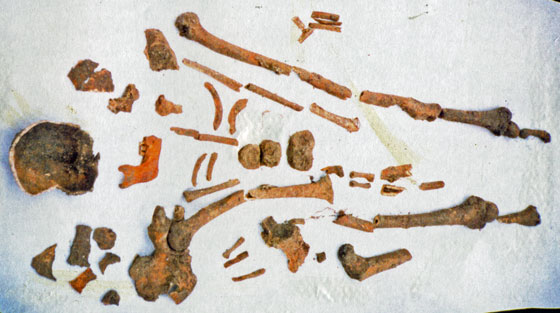
Remains of at least two skeletons were found during the excavation of the footings for the studio extension at Warwick Lodge, Prospect Road.

These were taken by the police to Oxford University for examination and dating. The skeletons were found buried side by side in an east/west orientation, which would indicate a Saxon period Christian burial, about 1000 AD.

Bones found in Upton

Filed Under: History

Inclosure Award 1759

September 6, 2006

EXTRACT from INCLOSURE AWARD 1759

…AND WE DO HEREBY FURTHER SET OUT, allot, assign, appoint, determine and award unto and for the said Simon Eldridge all that other lot, plot, piece or parcel of land or ground lying in the Upper Mead and by the said Act intended to be divided and inclosed as aforesaid containing five acres, three roods and twenty two perches of Statute Measure (exclusive of all roads and ways) as the same is now admeasured, staked and set out which said last mentioned lot, plot, piece or parcel of land or ground is Bounded on the north by an allotment of Joseph Pomfrey on the south by an old inclosure called Saffron Close and the remaining part by an Orchard late Smallbone, on the east by the Lane leading through the Mead, on the west part by the allotment of Mr Tompkins and as to the fences and mounds to be made for dividing, separating and inclosing of the said last mentioned allotment of the said Simon Eldridge we do hereby award, order, direct and appoint that the hedges, ditches, fences, and mounds on the north side by the allotment of Joseph Pomfrey and on the east side by the lane leading through the Mead shall be made, maintained, supported, preserved, repaired and kept in repair now and at all times for ever hereafter by and at the expense of the said Simon Eldridge or of such person or persons who shall at any time or times hereafter be owner or owners, proprietor or proprietors of the said last mentioned lot, plot, piece or parcel of land and ground…

(Note: punctuation has been added and a few words given their later spellings.)

Filed Under: History

Upton Fire of 1933

July 31, 2006

A serious fire on June 6th 1933 destroyed a number of the historic houses and farms in the centre of Upton.

A short sequence showing the aftermath of the fire was captured on cine camera.

https://www.uptonvillage.co.uk/wp-content/uploads/2006/07/UptonFire.mp4


Filed Under: History

English Heritage Photo Archive

July 25, 2006

A number of photographs of old Upton can be found at the ViewFinder web site.

The National Monuments Record (NMR) is the public archive of English Heritage. It curates an archive of 7 million items which are relevant to the archaeology, architectural history and social history of England.

ViewFinder presents a selection of historic and more recent photographs from the National Monuments Record’s important collections.

Filed Under: History

Listed Buildings

July 25, 2006

Eight Listed Buildings in Upton are shown on the National Heritage List for England.

Upton Manor House

UPTON HIGH STREET SU5186 (North side) 11/169 Upton Manor House 25/10/51 (Formerly listed under Blewbury) GV II
Manor house, now house. C17, with early C18 additions, fenestration altered late C18. Knapped flint plinth; red brick in Flemish bond to right; red brick with flared headers in Flemish bond to left and to upper part of first floor to right; old plain-tile cross-gabled roof; various brick stacks. 2-storey, 3-window range. C20 six-panel part-glazed door to centre with moulded wood surround, overlight, and shaped hood on brackets. 16-pane unhorned sashes to ground and first floors left and right. 9-pane horned sash to first floor centre. Moulded brick band between ground and first floors. Originally 2-storey, 5-window range; the flat brick arches of the original fenestration and the blocked openings can be seen. Tile-hung cross-gables to left and right. Right return: 2-storey, 3-window range. Central 2-storey projecting bay, possibly former porch. C20 glazed doors to right. Irregular fenestration of sashes. Interior. Early C18 dog-leg staircase with wood baluster balustrade and wood panelled dado. Early C19 straight-flight staircase with stick balustrade. Open fireplaces to ground floor right. Mid or late C19 addition to left of 2-storey, 2-window range.

Well Cottage

UPTON STREAM ROAD SU5186 (North side) 11/173 Well Cottage GV II
House. C17. Uncoursed stone rubble, part-rendered and painted; thatch roof, half-hipped to left; end stack to right. Probably single-unit plan. Single storey and attic; single-window range. C20 door and porch to C19 lean-to addition to right return. 3-light casement to ground floor centre with wood lintel. Swept half-dormer to centre with 3-light casement. Interior not inspected but noted as having open fireplace to ground floor.

Stocks

UPTON STREAM ROAD SU 5186 (north side) 11/175 Stocks – II
House. C17 with C20 alterations. Stone uncoursed rubble plinth; large timber- framing with angle-braces to first floor and C20 brick infill, some in herringbone pattern; thatch roof; brick ridge stack to centre. Probably originally 2-unit lobby entry plan. 2-storey, 2-window range. Plank door to centre. Irregular fenestration of C20 casements. Interior: C20 open-well staircase from ground floor to attic. Queen-post roof with wind braces. Chamfered spine beams to ground floor with ogee end stops. Open fireplace to ground floor left. Some, possibly C17, plank doors.

Church of St Mary

UPTON CHURCH STREET SU58NW (East side) 4/168 Church of Saint Mary 24/11/66 – II*
early C20 porch and Church. Probably C12; restored 1885, including flint facing; C20 porch and vestry. Coursed squared knapped flint to nave with stone quoins; unknapped flint to chancel; old plain-tile roof to nave; C19 plain-tile roof to chancel; C19 wood bell-cote with wood-shingle pyramidal roof to left. 4 and a half-bay nave with chancel plan. Plank door to centre of nave with romanesque round-arched doorway having zig-zag moulding. C20 timer-framed gabled porch. Lancet to left. C19 three-light stone mullion window to right with ogee-shaped heads to lights. Trefoil-topped paired lancet to left of chancel. Romanesque lancet to right of chancel. C19 three-lancet window to east end of chancel. Rear: lancets to chancel and nave. Lean-to vestry to right. Interior: C19 braced collar-truss roof to channel. C19 altar rail, choir stalls, and encaustic tiles to floor. Romanesque round chancel arch with dog-tooth moulding to imposts. Nave: C15 queen-strut roof with 2 rows of wind braces; Romanesque round stone font on C19 base. Round-arched doorway to vestry. (Buildings of England: Berkshire: 1975, p247; St. Mary’s Church, Upton by M. Chitty, 1984)

Crossings

UPTON STREAM ROAD SU5186 (North side) 11/174 Crossings GV II
House. Dated 1706 to datestone to left return. Painted part-rendered squared coursed stone; old plain-tile roof, hipped to left; brick ridge stack to centre. 2-unit lobby-entry plan with wing to rear left. Single storey and attic; 2-window range. C20 plank door to centre with segmental brick head. 3-light wood casements to left and right having segmental brick heads. 2 raking dormers with 3-light casements. Interior not inspected.

Owlscote Manor Farmhouse

UPTON HIGH STREET SU5186 (North side) 11/170 Owlscote Manor Farmhouse 24/11/66 (Formerly listed as Owlscote) GV II
Farmhouse, now house. Mid C17 with C18 front. Red brick with flared headers in Flemish bond old plain-tile roof, hipped to left; brick ridge stack to centre, and stack to right. Probably 2-unit lobby-entry plan. 2-storey, 2-window range. Plank door to centre with segmental brick head and flat hood. C20 three-light casements to left and right with segmental brick heads. C20 three-light casements to first floor left and right. Painted wood dentil cornice to eaves. Wing to right. C17. Render, probably on timber-framing; large timber-framing, with rendered infill above; old plain-tile roof, half-hipped to right. Single storey and attic; single-day range. 3-light casement to ground floor. Gabled dormer with 3-light casement. Interior not inspected.

Old Stream Cottage and Springside Cottage

UPTON STREAM ROAD SU5186 (North side) 11/172 Springside Cottage and Old Stream Cottage GV II
House and addition, now 2 dwellings. Early C18, with C19 addition to right. Painted stone uncoursed rubble, part-rendered; old plain-tile roof; brick end stacks. 2-storey, 3-window range. C20 glazed door to centre with C20 lean-to porch. 2-light casements with wood lintels to all openings except single-light casement to first floor centre. C19 addition to right; painted brick; old plain-tile half-hipped roof. Single storey and attic; 2-bay range. C20 door to right with C20 porch. 3-light casement with segmental brick head to left. 3-light raking half-dormer to left. Interiors not inspected. Included for group value.

Barn and Granary approximately 20 metres west of Owlscote Manor Farmhouse

UPTON HIGH STREET SU5186 (North side) 11/171 Barn and granary approx 20m W 24/11/66 of Owlscote Manor Farmhouse (Formerly listed as Barn at Owlscot) GV II
Barn and granary. Probably C17, with C20 alterations. Red brick, with some areas of small timber-framing. C20 plain-tile roofs, hipped to barn, half-hipped to granary. Probably 8-bay barn. Irregular C20 fenestration. Interiors not inspected.

Filed Under: History

« Previous Page
Next Page »

Subscribe to the monthly Upton News by providing your email address here or emailing news@uptonvillage.co.uk

You can read

Oxfordshire County Council news

or

Sign up to County Council residents’ newsletter

Home Library Service

Upton seen in 1930

Panorama of Upton looking north

This photograph of Upton was taken from a point south of the George and Dragon

Read more >

St Mary’s, circa 1900

St Mary's, circa 1900

St Mary's, circa 1900

St Mary’s interior, circa 1900

St Mary's interior, circa 1900

St Mary's interior, circa 1900

© Copyright 2022 Upton Village